
Operator-vetted e-com talent
You are still the bottleneck
Your ads can scale. Can your team?
Operator-tested specialists for every seat in your e-commerce team, from creative strategist to supply chain. Proven on a real work test before you meet them, so you stop hiring the best talker.
Five questions, about a minute. See an example shortlist for your seat.
- €0 until your hire starts
- 90-day replacement until 31 December60-day replacement
- A scorecard on every candidate
The diagnosis
Three gaps. One of them is yours.
Whatever you sell, growth stops in one of three places. The same three for a dropshipping store riding two winning products and for a subscription brand doing $1M+ in MRR.
You already know which one is yours. You have said it out loud this year.
01
The Knowledge Gap
"I can't judge a media buyer."
- What it costs
- Months of burned spend on a hire who interviewed well. You cannot grade work you have never done yourself.
- What closes it
- An operator who has done the job scores the work before you ever see the person.
02
The Capacity Gap
"It's faster if I do it myself."
- What it costs
- Your growth stops at your own hours. Every seat you cover yourself is a ceiling you built.
- What closes it
- Tested people in days instead of months, and pods when one pair of hands is not enough.
03
The Economics Gap
"I can't afford good people."
- What it costs
- Margin goes to overhead instead of growth, and a bad hire costs more than the seat staying empty.
- What closes it
- Someone who pays for themselves in the seat, and a 60-day replacement so one wrong call does not cost you a quarter.
So why does the same thing keep happening, hire after hire?

The root cause
You are hiring the interview
The way you hire was built to find people who interview well. It was never built to find people who can do the job.
So the talker gets the seat, and the work lands back on your desk. Here is what that costs you.

Your evenings go to the search
Two hundred CVs and twelve calls, squeezed in after the real work is done. Every step of it runs through you.
The best talker wins
Interviews reward the person who presents best. You find out what they can actually do three months later.
Budget burned by the wrong hire
"A bad hire will cost you way more than pausing sales ever would." Every week they stay, the ad account pays for the lesson.
Growth capped at your hours
While the seat is open, the job lands back on you. Your brand only grows as far as your own calendar stretches.
Interview fatigue: you settle
By the tenth interview everyone starts to sound fine. You hire whoever is in front of you just to end the search, or your COO picks someone who suits them. Either way you settle for good enough, and the A-player you set out to find never makes it to the call.
I made this mistake myself, more than once. It is why we score the work first: you only meet people who already passed.
The part nobody says out loud
"Nobody does it like I do."
You built this by doing every job. So you keep the edit and the final say. It feels like control. It is the ceiling.
The fear underneath is fair: you are only as good as your weakest team member, and the wrong person sinks the month. So you never let go. The only thing that breaks that loop is proof, before anyone starts.
Run a winning team
A team that decides what to test and ships winners every week. You back on growth, deciding where the brand goes instead of approving every edit. That is the job you actually wanted.

"They hire people to tell them what to do. We hired people to tell us what to do."
"Here lies a man who knew how to enlist in his service better men than himself."
Fine. So how would you ever know a hire is good before you bet a quarter on them?
How we test
We test the work first
Before anyone reaches you, they have done the job for real. I grade it myself.
-
The screen
Real numbers from their last seat and a recorded interview. Most people stop here.
-
The work test
About an hour of real work for a real brand, graded on one fixed scorecard.
-
The operator call
Someone who did the job goes through it line by line. If we would not put them on our own account, you never see them.
Gates, not rounds. Everyone says vetted. We show you the scorecard.
Example candidate card
WinningHire bot
#brand-hiring
New candidate for Creative strategist, candidate 03 of 5.
Scorecard 8.4 / 10 · Work test passed
Summary Strong on avatar research and UGC hooks; briefs are editor-ready. Weaker on statics. Best fit: brands and dropshipping stores testing at volume on Meta and TikTok.
Interview recorded by our team, full AI summary attached
Rate and availability stated in full on every card
Example card. It lands in your dashboard, blind until you commit, and by email for a timestamped record.
And who decides what good looks like? Someone who has paid for bad.
The operator
We've been the client
Built by an operator who has driven $30M+ in e-commerce sales and scaled a brand past $10M a year. Every seat in the growth team, filled and managed first-hand: creative strategists, media buyers, editors, ops.
We know what good looks like because we paid for bad. That is the whole reason the work test exists.
- Total sales
- €27.5M
- Orders
- 661K
- Sessions
- 11.3M
- Conversion rate
- 5.46%

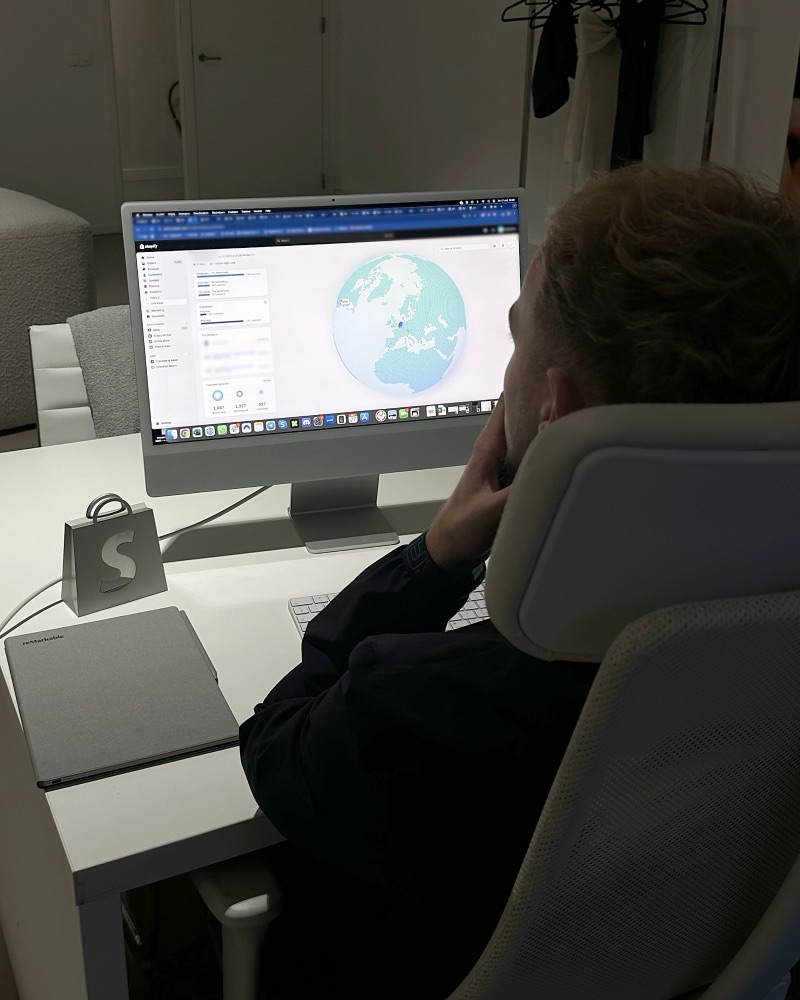


One store, December 2021 to August 2026, straight from the analytics.
Check it yourself
Do not take a screenshot's word for it
That is the store's own Shopify app, recorded on a phone. On the call we open the analytics live on screen, so you see the numbers move. Ask for it.
Creative is where most brands bleed first. It is not the only seat we fill.
The seats we fill
Every seat in an e-commerce team
From the editor cutting your next hook to the CFO reading your margins.
The dark ones get the most requests right now, from the biggest players in e-commerce.
Leadership
- CMO
- COO
- CFO / Finance Lead
- Head of Growth
- Head of E-commerce
- Head of Operations
- Fractional CMO / COO
- Head of Creative
- Brand Manager
Growth & Performance
- Media Buyer (Meta, TikTok, Google)
- Performance Marketing Manager
- Google & YouTube Ads Specialist
- Amazon PPC Specialist
- Retention & CRM Manager (Email/SMS)
- Affiliate & Partnerships Manager
- Influencer Marketing Manager
- SEO Specialist
- Marketplace Manager (Amazon, TikTok Shop)
Creative
- Creative Director
- Creative Strategist
- Creative Producer
- Video Editor
- Motion Designer
- Graphic & Static Ad Designer
- AI Content Creator
- UGC & Creator Manager
- Copywriter
- Product Photographer
- Organic Content & Social Media Manager
- Community Manager
Store, CRO & UX
- CRO Specialist
- UX/UI Designer
- Shopify Store Designer
- Landing Page & Funnel Builder
- Email & Klaviyo Designer
- Store Manager
Operations
- Supply Chain Manager
- Product Researcher
- Product Sourcer
- Supplier & Fulfilment Manager
- Product Lister / Catalog Specialist
- Inventory & Logistics Coordinator
- Customer Experience Lead
- Customer Support Specialist
- Project Manager
- Bookkeeper
- Executive Assistant / VA
Tech & Data
- Shopify Developer
- Front-end Developer
- Tracking & Attribution Specialist
- Automation & AI Specialist
- Data Analyst
Creative Strategist
Meta stopped letting you buy an audience. The creative is the targeting now.
So your paid media runs on a Creative Engine: the volume of angles and concepts you can ship every week. The strategist decides what goes into it. That makes this the most important seat for scaling, not just another hire.
Start single, then build the pod
Start with one strategist. Add the pod once the first winners land: one strategist briefs, two editors produce.
Fast-fill seats like support, listing and UGC: tested candidates in days. The senior seats take longer, because the bar is higher.
The stack behind the engine
A strategist can run that engine today with Higgsfield, Seedance, Kling, ElevenLabs and HyperFrames, and we have developers who will set it up for you.
The engine still needs a point of view to feed it. Whether a concept is shot with real people or generated, someone has to decide what is worth making. That is the strategist.
Whichever seat it is, it is open right now. That has a price.
The cost of waiting
What the open seat costs you
It is not always an empty chair.
Sometimes the seat is filled by someone you already know you have to replace. You keep postponing it, because the conversation is uncomfortable and because they are, at least, there. That one costs you more than the empty one. Every founder reading this knows which seat I mean.
Today
In 3 months
In 6 months
In 12 months
You waitYou do the job yourself between everything else. It gets done late and you tell yourself that is fine for now.
The same concepts are still running. You start a hiring round, read forty CVs and stop.
Half a year of output decided by whatever you had time for. The conversation with the wrong hire still has not happened.
A rushed hire, because by now the seat has to be filled by someone. You are back where you started, a year poorer.
You fill itOne call. We know which seat is open and what good looks like in it.
Tested candidates in your Slack, interviewed and scored. Someone is in the seat and past day 30.
They own the work. You check in instead of doing it. The replacement window has already closed clean.
A seat that compounds: someone who knows your margins and your customer better than a new hire ever could.
So what does it take to get there?
How it runs
Your own account manager, and a team doing the heavy lifting
One person owns your seat. They take the brief, run the search with our team, and bring you people who have already done the work. You interview as many as you like until one fits.
Account managerMorning. Which seat are we filling, what is the budget, and how many hours a week does it need?
YouCreative strategist. Around €3,000 a month, roughly 30 hours a week.
Account managerGot it. I will brief the team today and come back with tested people.
Candidate 03 of 5 Scorecard8.4 / 10 Work testPassed AvailableIn 2 weeks
Account managerFive passed the test. Interview as many as you want, and if none of them is right I will bring you more.
YouBook 03 and 05.
Interview until it fits
You meet as many tested candidates as you want. We keep going until one fits as closely as a person can.
AI makes our team faster. People make the call.
The offer
Nothing to pay until your hire starts
No cure, no pay. We carry the search and the work test. If nobody ends up in your seat, you owe us nothing.
€0
Until they start
You pay when someone is in the seat and working. Not before.
1
Invoice a month
Your specialist's rate plus 15%. Nothing else. You pay Winning Hire, we pay your specialist.
Until 31 December
60 90 days60 days
Free replacement
Peak season shows you which seat broke. Sign before the year ends and your replacement window is 90 days instead of 60.
Fewer than 3% ever need it. If yours does, the next one is on us.
And this is all you do
A short intake with your account manager. They take what they need and start the same day.
1
Intake
The seat, what good looks like, the budget and the hours.
2
Testing
We screen, interview and run a real work test for the role.
3
Shortlist
Tested candidates in your dashboard, with scores and summaries.
4
Placement
You, the specialist and Winning Hire sign one agreement.
5
Ongoing
Check-ins at day 7, 30 and 60. Most bad hires are bad onboarding.
You have paid for hiring before. Here is how it stacks up.
Where we sit
You have already tried the others

- Operator-vetted
- Real work test
- Tested in days
- One owner for the seat
- Replaced free
The others
Vetted by operators
You vet
You vet
You vet
You vet
Real work test
None
None
None
Build it yourself
Time to candidates
You search
You search
You screen
Weeks
Account manager
Self-serve
Self-serve
Self-serve
That is you
If it does not work
Start again
Start again
Start again
Start again
Statements about other platforms describe their published model only: open marketplaces and job boards where listings are self-reported and the vetting is the buyer's. We make no claim about the quality of anyone's talent but our own.
That is the model. Here is what it has already filled.
Placements
230+
Successful hires
Placed and managed across every seat in an e-commerce team, for brands and dropshipping stores worldwide.


From the seat
In the words of the people we placed
Every one of them passed the same work test your candidates will. This is what they did once they were in the seat.
I was skeptical. Every agency promised me ‘scale’ and then handed me a dead account.
Here I rebuilt the whole Meta structure: broad TOF prospecting, MOF retargeting on engagers and video viewers, BOF on add-to-carts and site visitors. Clear budget split per stage, creatives tested in their own campaign before they graduate to scaling. Within two months the account stopped guessing. That only works because they put me with a team that actually understands media buying.
I almost skipped the work test.
Felt like one more hoop. Turned out it was the first time anyone judged my actual work instead of my CV. Within a month I owned the account, not just the buttons in Ads Manager.
I thought I’d be the outsider, the freelancer who gets a brief and disappears.
Instead I was in the weekly creative meeting from day one. Six months later I’m the one writing the briefs, owning the angles and telling the team what we test next. It doesn’t feel like a placement anymore. It feels like my team.
The questions founders ask me on the call, answered here first.
Questions
What founders ask first
The six that come up on nearly every call. If yours is not here, it is the first thing we cover.
What makes you different from Upwork or Fiverr?
Those are marketplaces: they give you access and leave the judging to you. We do the judging. Every specialist does a real work test, scored by someone who has run that seat, and you get an account manager who knows your brand. You are buying a decision, not a search box.
How does payment work?
Nothing is due until your specialist starts. From then on it is one invoice a month to Winning Hire, billed monthly in advance: your specialist's rate plus our 15%, nothing else. We pay the specialist. You get every number in writing on the intake, before anything is signed.
How quickly can someone start?
Tested candidates in days on fast-fill seats like support, listing and UGC. Senior and specialist seats take longer, because the bar is higher and we will not drop it to make a deadline. Most brands have someone working within two to three weeks of the call.
Which roles can you fill?
52 titles across leadership, growth, creative, store and UX, operations, and tech and data. From a video editor to a fractional CMO. If the seat exists in an e-commerce team, we test for it.
What if I am not happy with the hire?
Fewer than 3% of our hires ever need replacing, because of the screening and the work test. If yours does, we replace them free within 60 days on the terms in your Client Agreement. We are paid monthly while they are in the seat, so a placement that churns costs us before it costs you.
Are they employees? What is my exposure?
They are independent contractors running their own business, engaged through one written agreement between you, the specialist and Winning Hire. We are not their employer and neither are you. No payroll, no local employment registration, and the agreement says so in writing.
Every week it stays open, you are the one filling it.
The seat is still open
On the call we find the seat that is holding your growth back and put a number on what it already cost you. Then we sketch the team you will be running 90 days from now.
You leave knowing exactly who to hire next, whether you hire them through us or not.